


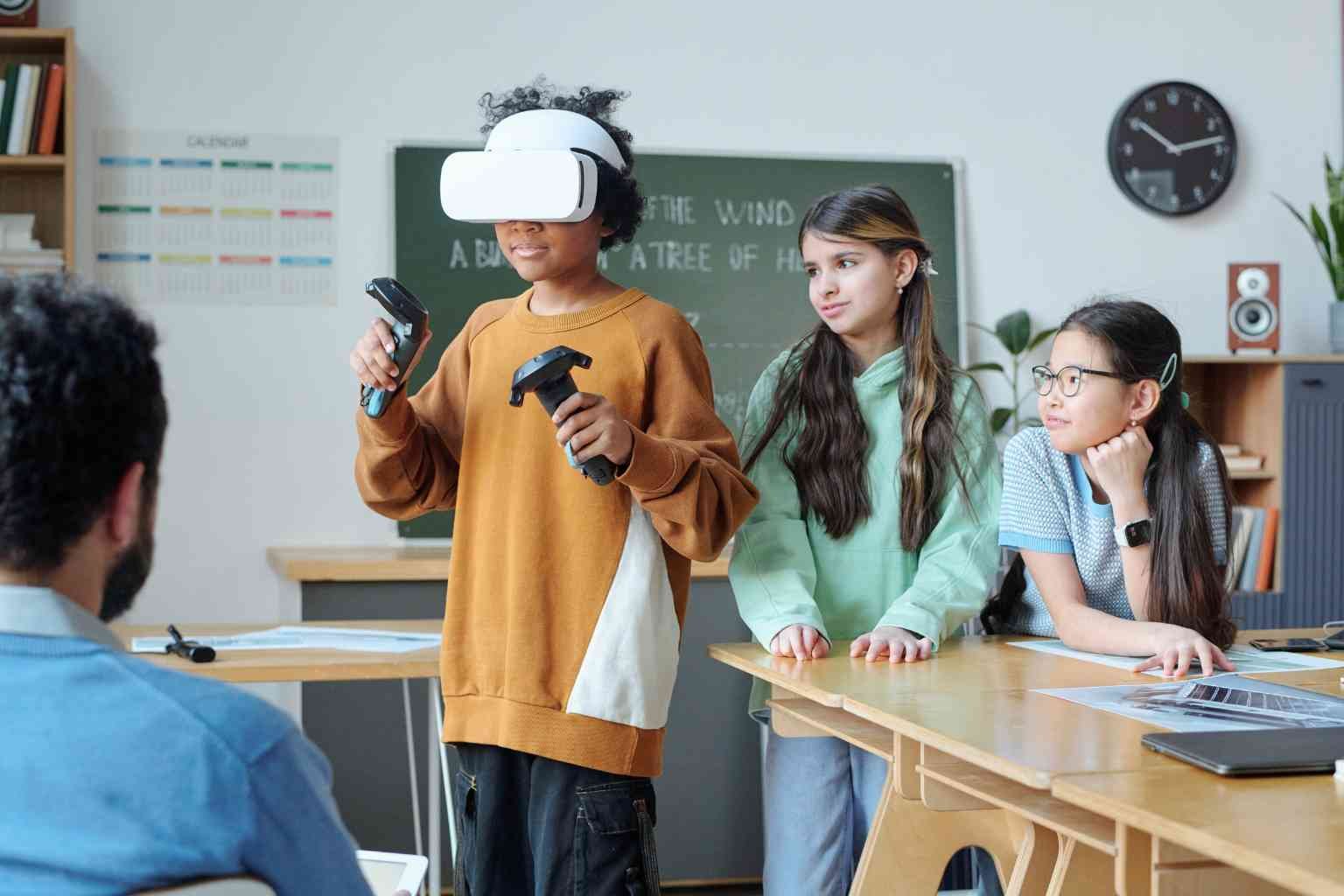
One of the most stimulating innovation and new technologies that can keep up with the evolution of education are Virtual Reality. Virtual reality, or VR, provides students with a new kind of learning experience. Students don’t just read or listen, they can explore three-dimensional spaces, run experiments in digital worlds and manipulate electronic objects. Which makes it a little bit more interactive and real and understandable.
1. What Is Virtual Reality in Education?
Virtual Reality in education refers to the application of VR technology to develop immersive learning experiences. Students wear VR headsets and enter a virtual world in which they can engage with lessons and simulations.
2. The Benefits of VR for Education Why VR Is Taking Off in Education
vr provides interactive learning. it exposes students to real life simulations. it helps students understand complex topics
3. How Virtual Reality is Useful in Learning Process
Virtual reality has many benefits in education today:
- Interactive and immersive learning experiences
- Better understanding of complex subjects
- Increased student engagement and interest
- Safe environment for practical experiments
- Improved memory retention
All these benefits contribute to VR being a powerful way to learn.
4. Virtual Reality in Practical Education
[ Ed note: this article was written by Loris B. Lemaire and Judith R. Denson, and is part of a series we are publishing in conjunction with the HAPS.
Virtual Reality (VR) is used widely in science and medical education. Students can conduct virtual experiments, learn about human anatomy and practice procedures without any risk to the real world.
5. How VR Enhances Learning Experience
VR creates do-it-yourself learning for students. Rather than planting it in the soil of passive learning, students engaging in lessons insteadhelps to increase comprehension and memory retention.
6. Visual Examples of VR in Various Subjects
- Historical concepts learnt through doing virtual tours of historical sites
- Geography with interactive maps and terrains
- Virtual labs and experimentation for science
- Engineering with design simulations
- Into Real Life: Learning Languages With Experiences
These apps add practicality to schooling.
7. The Role of Teachers in VR Based Learning
virtual reality teachers guide students through virtual learning experiences. they create real world connections for students. they help bridge virtual learning with classroom learning.
8. Challenges of Using VR in Education
VR has its challenges, despite its benefits. The high cost of equipment, low availability and the requirement for technical support make it difficult to implement for some schools.
9. Impact on Student Engagement
vr enhances student interest and participation. students enjoy learning, they are more likely to keep at it and do better in school
10. The Future of VR in Education
Virtual reality As technology becomes cheaper and more widely available, it is anticipated that virtual reality will grow in schools. It will lead to an increased use of VR in schools and give students the immersive experience they cannot receive from a robotics sets, along with personalized learning.
Key Takeaways
- One of the educational sectors which is also getting transformed by virtual reality technology is modern education systems
- Easy for students to learn through hands-on recreations of lessons making things easier to understand and remember
- The expansion of VR technology will play an increasingly large role in the future of education
FAQs:
Q1. What is virtual reality in education?
This is called the application of VR technology to build immersive, interactive learning experiences.
Q2. How can Virtual reality help the students in learning?
It gives students an opportunity to visualize concepts in a practical manner.
Q3. What fields incorporate VR technology in education?
VR is utilized in subjects such as science, history, geography and engineering.
Q4. Is VR expensive for schools?
vr is pricey at the moment. it will get cheaper over time.
Q5. Are you going to find VR in classrooms?
Yes, as technology becomes more accessible it is predicted to expand
